What Is Al Sajaa?
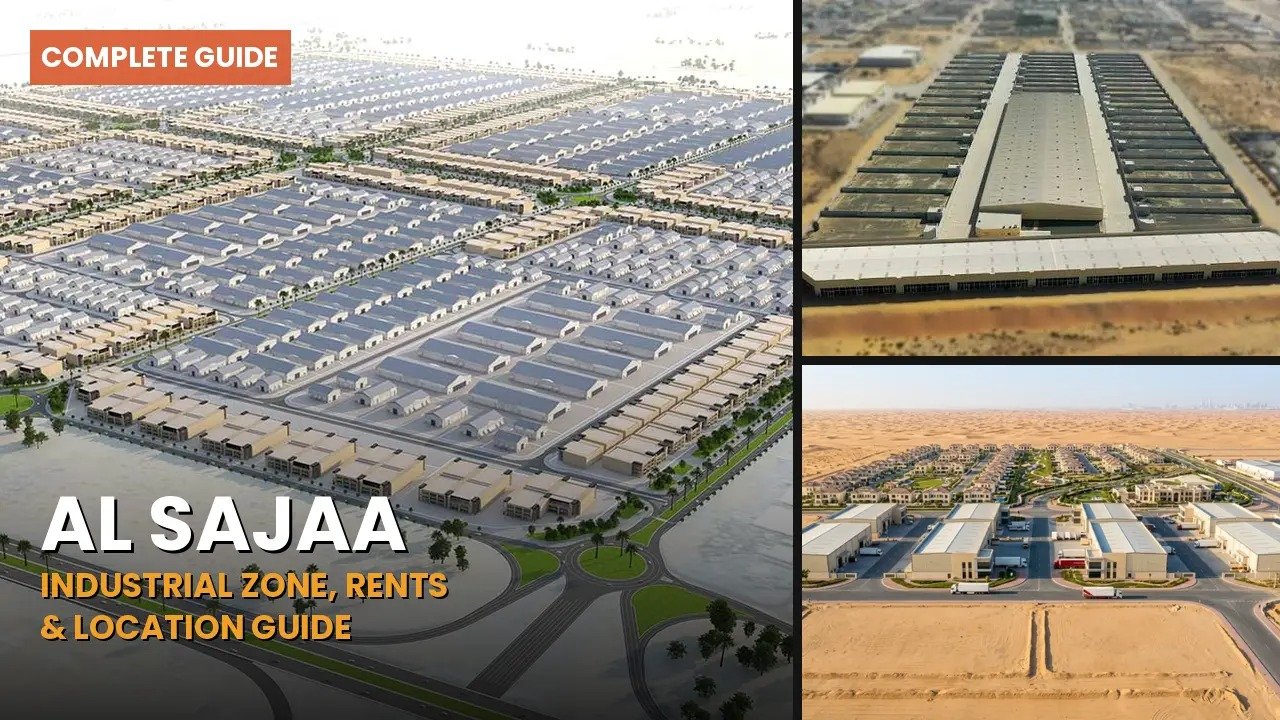
Al Sajaa is an industrial district in Sharjah, United Arab Emirates, sitting on the Sharjah–Dhaid highway next to Emirates Road (E611). The name covers three distinct things people search for: the original settlement and coordinates located at 25°19′50″N 55°38′37″E, established in 2008, the large-scale Al Sajaa Industrial Oasis development, and the separate Sajaa gas field. Most people typing “al sajaa” today mean the industrial zone.
- What Is Al Sajaa?
- Where Is Al Sajaa and Why Its Location Matters?
- Al Sajaa Industrial Oasis: The Investment Product
- What Kind of Businesses Operate in Al Sajaa?
- Is Al Sajaa a Free Zone or a Mainland Area?
- How Much Does It Cost to Rent or Invest in Al Sajaa?
- The Newest Development: Sajaa Bonded Dry Port
- Who Is Al Sajaa Right For?
- Operational Challenges to Plan For
- Areas Near Al Sajaa
The three things “Al Sajaa” can mean — disambiguated
| Meaning | What it is | Why it matters |
|---|---|---|
| Al Sajaa (place/settlement) | A settlement in Sharjah on the Sharjah/Dhaid highway, adjacent to Emirates Road (E611), covering about 1.30 km² | The administrative and geographic anchor for the whole district |
| Al Sajaa Industrial Oasis (ASIO) | A planned 14 million sq ft industrial zone developed by Sharjah Asset Management Holding (SAM), with an initial 353 development plots ranging from 13,454 to 53,819 sq ft | This is the actual investment/leasing product most searchers want to compare |
| Sajaa gas field | Discovered on Amoco’s concession in Sharjah in December 1980, later described as Sharjah’s largest producing field and first gas-condensate development | Explains why some search results mix industrial-zone content with oil-and-gas history |
Where Is Al Sajaa and Why Its Location Matters?
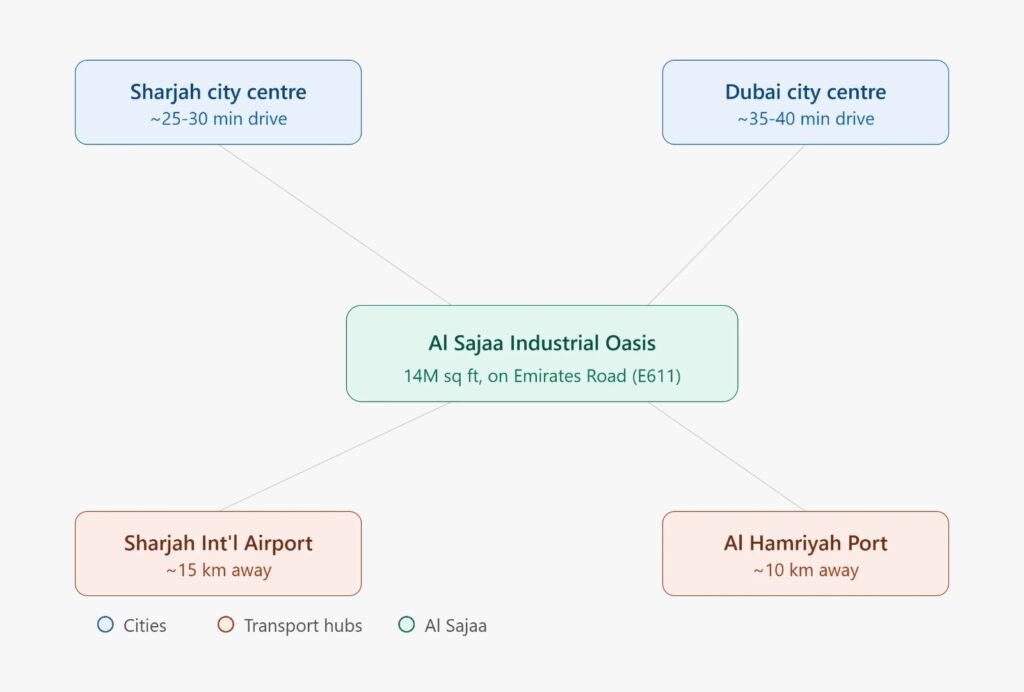
Al Sajaa sits directly along Emirates Road (E611), which is the main artery connecting Sharjah to the northern emirates, putting it close to Sharjah International Airport and Al Hamriya Port without needing to enter central Sharjah traffic. That combination highway, airport, seaport, is the actual reason logistics and distribution companies choose it over more central industrial areas, not just its size.
Location snapshot
| Factor | Detail |
|---|---|
| Coordinates | 25.3306°N, 55.6435°E |
| Main road access | Sharjah–Dhaid highway, adjacent to Emirates Road (E611) |
| Nearest airport | Sharjah International Airport |
| Nearest seaport | Al Hamriyah Port and Free Zone |
| District established | 2008 |
| Total settlement area | 1.30 km² (0.50 sq mi) |
Public transport is limited, there’s no metro line, so most daily movement runs on company buses, private vehicles, and shared taxis rather than a fixed transit schedule. Anyone planning to work there without a car should confirm shuttle arrangements with their employer before committing, since this is a genuine practical gap that catches new workers off guard.
Getting to Al Sajaa: driving and public transport
By road, Al Sajaa sits roughly 25–30 minutes from Sharjah’s city centre and around 35–40 minutes from central Dubai via Emirates Road (E611), traffic depending, treat these as approximate driving windows rather than fixed times, since they shift with the hour of day.
Public buses do serve the district directly, terminating at Al Saja’a Terminal:
| Route | Direction | Origin/destination |
|---|---|---|
| 77 | To Al Saja’a Terminal | Muwaileh Bus Station 4 |
| 88 | To Al Saja’a Terminal | Al Rolla Terminal Station 4 |
| 88X | Return | Al Saja’a Terminal → Al Rolla Terminal Station 4 |
| X88 | To Al Saja’a Terminal | Al Rolla Terminal Station 4 (express variant) |
Route data as of publication — via 2GIS.
From Dubai, there’s no single direct service, the practical route is Dubai Metro to a connecting point, then a local bus or taxi onward to Al Saja’a Terminal.
Al Sajaa Industrial Oasis: The Investment Product
Al Sajaa Industrial Oasis (ASIO) is the master-planned development that turned the district into what’s often called the largest industrial zone in the UAE. It consists of a total of 353 plots stretching over 14 million square feet, and is supported by the Government of Sharjah, with freehold available to UAE, GCC, and Arab nationals. Non-Arab expats can still participate, but on a 100-year leasehold basis rather than freehold . This distinction matters because it directly affects whether you can trade freely across the UAE or face local-market restrictions so it’s worth confirming before signing anything.
Plot and unit types available
| Unit type | Typical size range | Who it suits |
|---|---|---|
| Industrial plots | 13,454–53,819 sq ft (launch inventory) | Manufacturers, heavy storage operators |
| Warehouses | 550–215,280 sq ft covered area | Logistics, e-commerce fulfillment, distribution |
| Commercial plots | 11,885 sq ft–1,000,000 sq ft | Large-scale storage and mixed commercial use |
| Retail/shops | 200–700 sq ft | Small support businesses serving the industrial workforce |
| Labour accommodation | Varies; includes parking, storage, laundry facilities | Housing for on-site industrial workers |
Use this table as a quick reference when comparing plot sizes against your business’s space requirements before contacting a broker.
What Kind of Businesses Operate in Al Sajaa?
Al Sajaa’s tenant base is dominated by manufacturing, automotive services, and storage/logistics operators, reflecting the district’s plot mix of heavy industrial land and large-format warehousing rather than office or retail space.
Business categories active in the district
| Category | Typical activities | Space type used |
|---|---|---|
| Metal and fabrication | Steel and aluminium cutting, shaping, and welding for construction and automotive parts | Industrial plots |
| Plastics and chemical processing | Molding of containers, pipes, and industrial components | Industrial plots |
| Packaging and furniture manufacturing | Production of containers, packaging materials, and furniture for homes and offices | Industrial plots, warehouses |
| Automotive parts and repair | Spare-parts trading, engine repair, and vehicle servicing workshops | Shops, small commercial units |
| Scrap metal and recycling | Ferrous and non-ferrous metal trading, industrial scrap collection, and material recovery — a genuinely active secondary market in the district, with several established scrap-trading companies based there | Industrial plots, dedicated yards |
| Storage and logistics | Warehousing, freight consolidation, and distribution | Warehouses, commercial plots |
Is Al Sajaa a Free Zone or a Mainland Area?
Al Sajaa operates under Sharjah’s mainland licensing system (SEDD), not as a free zone — This is an important point that many area guides leave out, so it’s worth double-checking directly with SAM or a licensed broker before you commit. That means a company registered there can trade directly across Sharjah, Dubai, and the wider UAE market without the local-market restrictions that typically apply to free-zone entities, though it also means the standard mainland company-formation rules and fees apply rather than a free-zone package.
Sharjah’s separate free zones, Hamriyah Free Zone and Sharjah Airport International Free Zone (SAIF Zone) among them are different jurisdictions entirely and shouldn’t be confused with Al Sajaa when comparing setup options.
How Much Does It Cost to Rent or Invest in Al Sajaa?
Rental figures published across listing platforms vary enormously and the reason is simple: they’re pooling very different unit sizes and unit types under one district label, not that any single figure is wrong.
Reported rental ranges (concrete numbers, by source)
| Source | Reported annual rent range | Average annual rent | Note |
|---|---|---|---|
| Bayut (Al Sajaa) | AED 16,000–13,680,000 | AED 633,081 | Across 375 listed warehouses |
| Bayut (Al Sajaa Industrial) | AED 15,000–23,100,000 | AED 696,954 | Across 800 listed warehouses; -14% change over 6 months |
| Bayut (commercial, all types) | AED 2,000–23,100,000 | AED 628,351 | Includes shops, offices, plots, not just warehouses |
| Property Finder (Al Sajaa) | AED 12,000–565,000 | ~AED 265,000/month equivalent range cited | 550–215,280 sq ft size band |
| Emirates Industrial City (developer-direct) | From AED 45 per sq ft | — | Direct-from-developer, 0% commission, 3,000–47,000 sq ft units |
Why the range is this wide: a small 550 sq ft loading bay and a 215,280 sq ft mega-warehouse are both “warehouses in Al Sajaa” on paper, so any single average is close to meaningless without checking the size band first. Filter by your required square footage before comparing quoted annual rents, not the other way around.
The Newest Development: Sajaa Bonded Dry Port
On December 19, 2025, logistics operator Gulftainer launched its second bonded dry port in Sajaa, a 70-hectare inland logistics hub positioned between Sharjah and Khorfakkan Port, roughly 90 km apart. This is a genuinely new addition that most existing area guides haven’t caught up with yet.
Sajaa Bonded Dry Port at a glance
| Feature | Detail |
|---|---|
| Operator | Gulftainer |
| Launch date | December 19, 2025 |
| Total site size | 70 hectares |
| Interlocked yard space | 50,000 m² |
| Warehousing | 5,000 m² |
| Bulk and container storage | 30,000 m² |
| Distance to Khorfakkan Port | Approx. 90 km |
| Bonded status | Yes, goods can be stored duty-free until cleared |
| Positioned to serve | Northern Emirates, manufacturing zones, distribution hubs |
| Additional capabilities cited | Cold storage, last-mile connectivity, direct road links to UAE ports, planned future rail connection |
Being “bonded” matters practically: it lets importers and distributors hold cargo inland without paying duty until the goods actually clear, which shortens the cash-flow gap compared with clearing everything at the seaport first. Gulftainer has positioned the facility as a gateway specifically for northern-emirates trade and manufacturing distribution, with direct road links into UAE ports and a future rail connection flagged as part of its longer-term role in the network, an extension of freight reach that wouldn’t add more truck traffic to Emirates Road.
Source: Gulftainer’s official press release, December 19, 2025.
Who Is Al Sajaa Right For?
Al Sajaa suits industrial and logistics businesses that need scale and highway access at a lower cost than central Sharjah or Dubai, it is not built for residential or lifestyle use.
Good fit for:
- Logistics and distribution operators needing highway, airport, and port access
- Manufacturers requiring large industrial plots or heavy-duty warehousing
- Construction material suppliers and traders
- Scrap metal and recycling businesses
- SMEs scaling up from smaller Dubai or Sharjah industrial spaces
Not a good fit for:
- Residential or lifestyle seekers very few residential units exist, with no dedicated metro service
- Retail, dining, or entertainment-focused businesses
- Investors expecting freehold ownership without confirming eligibility first non-Arab expats typically fall under a 100-year leasehold rather than outright freehold, a detail worth checking before committing funds
Operational Challenges to Plan For
Al Sajaa is a working industrial zone, and a few practical realities catch newcomers off guard none of them make the area unsuitable for business, but each is worth planning around:
- Heavy truck traffic on the main access roads during business hours
- Limited public transport reach into the plots themselves the bus routes stop at Al Saja’a Terminal, with the last stretch typically covered by taxi or company transport
- Summer heat, which makes outdoor loading and yard work considerably harder roughly from May through September
- Minimal retail, dining, or lifestyle amenities compared with a typical city district
Planning around these company transport, working-hour scheduling, on-site facilities is part of operating there successfully rather than a reason to avoid the area.
Areas Near Al Sajaa
Al Sajaa sits within a broader cluster of Sharjah industrial and logistics zones, which matters if a specific plot or warehouse there doesn’t fit your size or budget:
| Nearby area | Relevance |
|---|---|
| Sharjah Industrial Area (Zones 1–18) | Sharjah’s older, more established industrial zones, generally closer to the city centre |
| Hamriyah Free Zone | A separate free-zone jurisdiction near Al Hamriyah Port, relevant if free-zone benefits matter more than mainland trading access |
| SAIF Zone (Sharjah Airport International Free Zone) | Another Sharjah free zone, positioned near the airport rather than Emirates Road |
| Muwaileh Commercial Area | Closer to central Sharjah, more commercial/retail-oriented than industrial |
No. Al Sajaa the settlement and industrial zone is a distinct entity from the Sajaa gas field, even though they share a name and location. The Sajaa gas field was discovered on Amoco’s concession in December 1980 and is Sharjah’s largest producing field, while the industrial zone is a separate, more recent commercial development.
Yes, with conditions. Arab nationals can access full-term investment, while non-Emiratis can buy or invest on a 100-year leasehold basis rather than outright freehold. Confirm current eligibility rules with SAM or a licensed broker before committing funds.
Reported annual rents span roughly AED 15,000 to over AED 23 million depending on size and listing source, because the figures pool everything from a 550 sq ft loading bay to a 215,000+ sq ft facility together. Always compare rent per square foot for your specific size requirement rather than the headline range.
Not primarily. It’s an industrial and commercial zone with limited residential stock; most people based there are workers in nearby labour accommodation rather than long-term residents.
There’s no dedicated metro service. Movement relies on company buses, shared taxis, and private vehicles via Emirates Road (E611) and the Sharjah–Dhaid highway, so confirming transport with an employer or landlord in advance matters more here than in metro-connected districts.
By road, it’s roughly a 25–30 minute drive from central Sharjah and around 35–40 minutes from central Dubai via Emirates Road (E611), though actual travel time depends on traffic and the exact plot location within the district.
The district is dominated by manufacturing (metal fabrication, plastics, packaging, furniture), automotive parts and repair services, and storage/logistics operators — reflecting its mix of heavy industrial plots and large warehouse space rather than office or retail use.
No. Al Sajaa operates under Sharjah’s mainland licensing system rather than as a free zone, which means registered companies can trade directly across the UAE market without the local-market restrictions that typically apply to free-zone entities. Sharjah’s actual free zones — such as Hamriyah Free Zone and SAIF Zone — are separate jurisdictions.