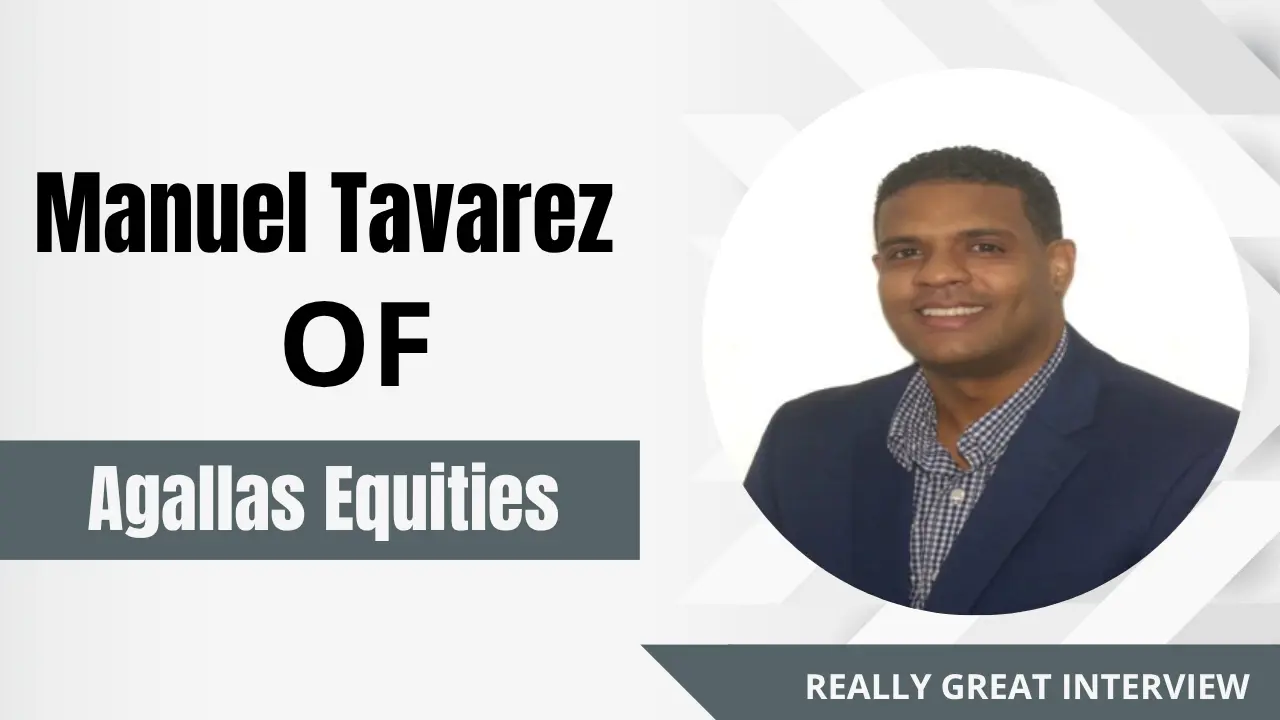
Manuel Tavarez is a living paradox. He navigates the high-stakes world of sovereign wealth funds and pension allocations with the quiet confidence of someone who once navigated the tough neighborhoods of the Bronx. His firm, Agallas Equities—the name itself translating to “guts” or “courage” in Spanish—is a fitting moniker for a man who has staked his reputation on bridging the gap between institutional discipline and community-rooted development.
Tavarez doesn’t fit the typical real estate fund manager mold. He holds a BS in Sports Management from Barry University and an MS from Pace University’s Lubin School of Business, but his real education came from the streets of New York City and the boardrooms of the city’s massive public pension systems. Before co-founding Agallas Equities, he sat on the other side of the table—as a trustee for two New York City pension systems managing a combined $118 billion in assets. That experience, steeped in fiduciary rigor and governance, now dictates exactly how he courts capital, structures deals, and executes on a global scale.
We sat down with Tavarez to discuss his improbable journey, his firm’s disciplined multi-strategy approach, the expansion into the U.S. housing market, and the upcoming launch of a global infrastructure fund.
Q: Your path to Wall Street and institutional finance is far from ordinary. How did your experience as an NYC pension trustee fundamentally reshape your investment philosophy?
Tavarez: It was the best MBA I never paid for. When you sit on the allocator side—vetting real estate managers, demanding granular transparency, and enforcing strict fiduciary standards—you see every flaw in the system. You learn exactly what institutional investors lose sleep over: liquidity risk, alignment of interests, and operational due diligence.
I took those lessons straight into Agallas. We don’t just say we have best-in-class governance; we live it. We pre-clear our conflicts, we over-communicate our drawdowns, and our quarterly reporting is built to pension-grade standards. That’s critical because we’re not just raising money from domestic family offices. We’re bridging capital from the Gulf Cooperation Council (GCC)—where sovereign funds and royal family offices have spent decades perfecting global diversification. They don’t just look at your IRR; they look at your process. If you can’t pass their operational audit, you don’t get past first base
Q: You grew up in a tough neighborhood in the Bronx. How did those roots influence the person you are today and the way you run your firm?
Tavarez: It made me who I am—period. In the Bronx, you learn the value of a dollar before you learn algebra. You learn to read a room in seconds, trust your gut, and understand that hard work isn’t optional—it’s survival. The streets taught me negotiation in a way that no textbook ever could. When you’re playing baseball in the Bronx parks, you learn patience at the plate, the discipline to wait for your pitch, and the resilience to keep swinging even when you strike out—which is surprisingly similar to negotiating a term sheet with a joint-venture partner. You don’t swing at bad deals; you wait for the right one, and when it comes, you drive it.
That environment forged a resilience that I carry into every boardroom. I’m not intimidated by billion-dollar balance sheets or Ivy League pedigrees. I carry the perspective of someone who had to fight for every inch of ground. Hard work isn’t just a virtue for me; it’s the only currency that’s never failed. That grit translates directly to our firm’s culture. We don’t cut corners on due diligence, and we don’t back down from complicated, ground-up developments. It also keeps me grounded—I remember exactly who we’re building these communities for. They look just like my neighbors did growing up. When we invest in workforce housing or sports facilities, I’m not just looking at cap rates; I’m looking at generational impact.
Q: Your academic path—Barry University’s Sports Management program followed by Pace’s Lubin School—seems unconventional for a real estate executive. How did that hybrid education prepare you for this role?
Tavarez: It was more intentional than it looks. First, Barry University gave me the big-picture vision. The BS in Sports Management wasn’t just about stadiums and scoreboards; it taught me the economics of anchor institutions. A sports facility isn’t just a venue—it’s an economic engine that drives hotel bookings, retail foot traffic, and neighborhood revitalization. I learned how to think about activation and community engagement, which is rare in pure finance.
Then, Pace’s Lubin School gave me the technical armoury. The MS program sharpened my quantitative skills to a razor’s edge—cap rates, discounted cash flow models, IRR waterfalls, and complex joint-venture structuring. I learned how to underwrite risk with institutional rigor.
That combination is my secret sauce. I can analyze the P&L of a luxury box suite and stress-test the debt stack of a $200 million mixed-use development—all in the same day. When I later sat on pension boards, that dual perspective—operational insight plus hardcore financial discipline—made me a better allocator of capital because I understood the business behind the assets, not just the spreadsheets.
Q: You launched your inaugural fund in late 2025 with a target of $400 million. Walk us through the strategy and the sectors you’re targeting.
Tavarez: The Agallas Equities Real Estate Fund I is laser-focused on high-impact projects in the Dominican Republic. We’re targeting a net IRR of 18–20% with a 3-to-7-year investment horizon. The strategy leverages three distinct moats: our deep regional networks, our ability to structure public-private partnerships (PPPs), and our unique “diaspora insight.”
We’re prioritizing three core verticals:
First, Sports & Entertainment—we’re developing modern, multi-purpose sports facilities that serve as economic anchors. These aren’t just stadiums; they’re mixed-use districts that attract international events and drive tourism.
Second, Tourism & Hospitality—we’re building climate-resilient luxury resorts under the CONFOTUR Law, which offers significant tax incentives for foreign investment. We’re incorporating hurricane-proof construction and sustainable water systems to mitigate climate risk.
Third, Infrastructure & Mixed-Use—we’re targeting transportation-adjacent developments and urban revitalization projects that align with the government’s national development agenda.
The diaspora angle is critical. There are over 2 million Dominicans in the U.S. , many of whom send remittances and are looking for tangible assets back home. They trust us because we speak their language, understand the cultural nuances, and have the institutional credentials to protect their capital.
Q: What makes the Dominican Republic such a compelling market right now, compared to other emerging economies?
Tavarez: The numbers are staggering. The DR recorded $5.03 billion in foreign direct investment in 2025, up 11.3% from 2024, with real estate accounting for 15.7% of that total. But it’s not just the volume—it’s the maturity of the market. The DR has a stable democracy, a legal framework that protects foreign investors, and a currency that is effectively pegged to the U.S. dollar. You get dollar-denominated returns without the currency risk that plagues other LatAm markets.
Meanwhile, Western real estate cap rates have compressed to 3–5%. Investors are desperate for yield. The DR offers a compelling structural arbitrage—18%+ IRRs with political stability and a government that actively courts foreign capital through tax incentives and streamlined permitting. For investors sitting on massive dry powder and searching for yield without the volatility of public equities, this isn’t an emerging market bet; it’s a sophisticated arbitrage play.
Q: Beyond the Dominican Republic, you’re expanding into the U.S. housing market. What’s the specific thesis there?
Tavarez: We’re a New York–based firm, and the U.S. remains our home base and a core pillar of our strategy. We specialize in mixed-use real estate, hospitality ventures, and retail developments. But specifically in housing, we are looking at value-add and distressed workforce housing in the Northeast and Sunbelt.
There’s a massive supply-demand imbalance in the U.S. housing market. With interest rates where they are, construction financing has dried up for many smaller developers. That creates an opportunity for well-capitalized firms like ours to step in and acquire Class B and C assets, renovate them, implement professional management, and deliver strong cash-on-cash returns while simultaneously providing much-needed attainable housing. We’re combining our institutional discipline with local market expertise to identify properties that others are overlooking. We’re not chasing trophy assets; we’re chasing value and necessity.
Q: You’re also preparing to launch a global infrastructure fund. That’s a major leap. What’s the vision there?
Tavarez: Infrastructure is the ultimate frontier for patient capital. We’re building on our experience with large-scale PPPs and massive development projects to create a vehicle that targets digital connectivity, renewable energy, and sustainable urban systems globally.
Think about it: the digital economy runs on fiber optics and data centers. The energy transition requires massive grid upgrades and battery storage. These assets offer long-term, stable cash flows that are uncorrelated with traditional real estate cycles. We’re currently in the structuring phase, partnering with engineering and construction giants, and engaging with insurance companies and pension funds who are desperate for inflation-hedged, long-duration assets. We expect to announce the first close of this fund in early 2027. It will target OECD and select high-growth emerging markets with transparent regulatory frameworks.
Q: What’s the biggest challenge in executing this multi-market, multi-asset strategy across the U.S., the Caribbean, and global infrastructure?
Tavarez: Without a doubt, it’s trust and regulatory complexity. Cross-border capital requires absolute transparency. We’re building bridges—between U.S. liquidity, Gulf sovereign wealth, and Caribbean real assets. That means we have to meet the highest anti-money laundering (AML) and Know Your Customer (KYC) standards in every jurisdiction. We have to navigate U.S. tax law, Dominican property law, and international investment treaties simultaneously.
But that complexity is also our competitive advantage. Very few firms have the cultural fluency, the institutional pedigree, and the operational grit to execute in all three arenas. When we walk into a room with a family office from Dubai, they know we understand their need for Sharia-compliant structures. When we talk to a U.S. pension fund, they know we speak their language of risk-adjusted returns. That versatility is our moat.
Q: Final thoughts—what keeps you going, and what do you want your legacy to be?
Tavarez: This isn’t just about returns; it’s about reshaping communities. Whether it’s a sports complex in Santo Domingo, a renovated apartment building in the Bronx, or a solar farm in the Midwest, we are creating spaces that drive growth, create jobs, and build a legacy for the next generation.
I came from nothing. I know what it takes to build something from the ground up—literally and metaphorically. The name “Agallas” means guts, courage, heart. That’s what this firm is built on. We take the smart risks that others shy away from, but we do it with discipline, respect, and an unshakable commitment to our partners and communities. I want to look back in twenty years and see not just a successful fund, but a blueprint for how diaspora expertise can lift both the communities we come from and the communities we invest in.
Agallas Equities is a New York–based real estate investment and development firm led by partners Manuel Tavarez and Nelson Tejada Jr., who bring nearly two decades of combined experience at leading financial institutions with expertise in investments, development, and cross-border execution. Specializing in real estate, hospitality, sports facilities, and retail, the firm combines market insight with a commitment to quality, sustainability, and community impact, delivering strong, risk-adjusted returns for investors while creating spaces that inspire, connect, and endure.
To learn more, users can visit www.agallasequities.com or contact contact@agaeq.com.