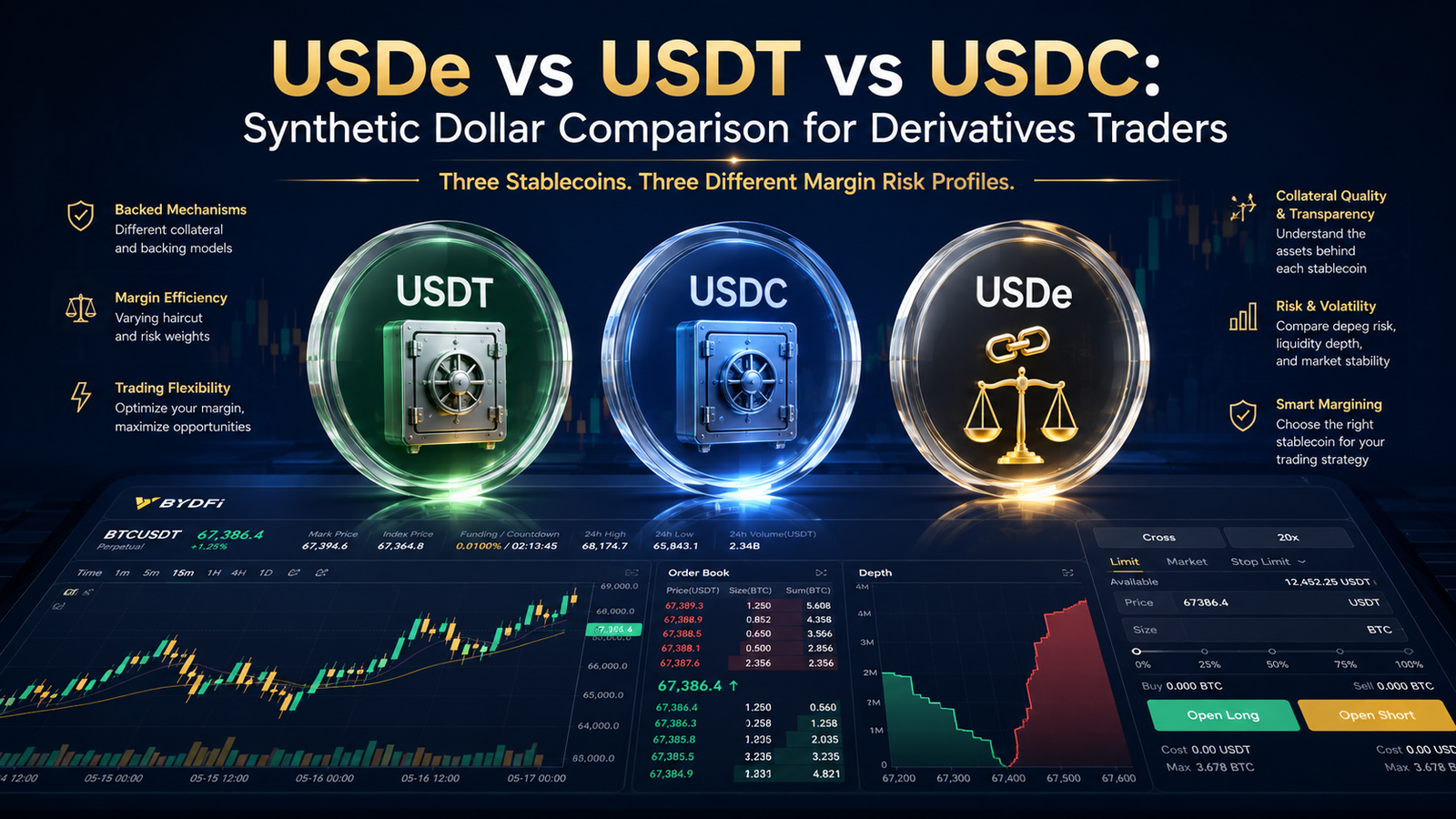
The dollar-pegged token sitting in your margin account isn’t neutral — it carries its own risk profile, and that profile changes significantly depending on whether it’s fiat-backed, reserve-attested, or synthetically constructed. This synthetic dollar comparison gained real urgency as derivatives exchanges began expanding their stablecoin-margined offerings, giving traders more choices beyond traditional USDT-based contracts.Traders who’d defaulted to USDT-M contracts for years suddenly had a genuine choice: USDT, USDC, or USDe. The differences aren’t cosmetic.
This comparison breaks down how each instrument maintains its peg, where each carries structural risk, and what those differences actually mean when one of them is sitting inside your margin account.
What “Synthetic Dollar” Actually Means — And Why It Matters for This Synthetic Dollar Comparison
A synthetic dollar is a crypto-native instrument engineered to hold a $1.00 value without a corresponding dollar sitting in a bank account. The term applies most precisely to instruments like USDe, which maintain their peg through on-chain mechanisms rather than fiat custody. Fiat-backed stablecoins like USDT and USDC are technically collateralized dollars, not synthetic ones — but all three compete for the same role in derivatives markets: collateral, margin, and settlement currency.
The distinction isn’t academic. A fiat-backed stablecoin carries issuer and custodial risk. A synthetic dollar carries protocol risk, smart contract exposure, and — critically — funding-rate dependency. When one of these instruments is your margin in a leveraged futures position, knowing which risk you’re actually holding changes the calculus of the trade.
Understanding leverage in derivatives markets means recognizing that your margin currency is itself a risk variable, not a neutral base.
How Each Dollar Peg Actually Works
USDT is backed by a reserve basket that Tether reports includes U.S. Treasury bills, cash equivalents, and other assets. It’s the largest stablecoin by market cap and carries the deepest liquidity across centralized exchanges globally, according to CoinGecko’s stablecoin metrics. Its peg is maintained through an authorized redemption mechanism. The risk profile is well-documented: reserve composition has faced regulatory scrutiny for years, and during acute market stress events, USDT has briefly deviated from its $1.00 anchor before recovering.
USDC is issued by Circle and backed by cash and short-duration U.S. Treasury securities held in regulated financial institutions, with monthly reserve attestations published independently. It experienced a notable depeg in March 2023 during the Silicon Valley Bank collapse — the peg recovered within days, but the episode demonstrated that even a well-audited fiat-backed stablecoin can wobble when its custodian is under pressure. USDC is generally regarded as the more regulatory-compliant of the two fiat-backed options.
USDe, developed by Ethena Labs, uses a synthetic dollar model rather than fiat reserves. It maintains its peg through a delta-neutral strategy involving crypto collateral and derivatives hedging. This design can generate yield opportunities but also introduces funding-rate and smart-contract risks that do not exist in traditional fiat-backed stablecoins.
The Comparison Derivatives Traders Actually Need
When the question shifts from “what is this token” to “should I use it as my margin currency,” the relevant dimensions are peg stability, liquidity depth, yield mechanics, and decentralization.
| Feature | USDT | USDC | USDe |
| Backing mechanism | Fiat reserves | Fiat + T-bills | Delta-neutral derivatives |
| Native yield | No | No | Yes (sUSDe staking) |
| Issuer / protocol risk | Tether (centralized) | Circle (centralized) | Smart contract + funding rate |
| Derivatives margin support | Widest | Growing | Limited (select venues) |
| Regulatory posture | Scrutinized | Compliant | No issuer entity; classification unresolved |
| Peg track record | Long; minor deviations | Strong; 2023 SVB depeg | Short history; no bear cycle test |
In practice, the trade-offs are relatively straightforward. USDT remains the liquidity leader, USDC emphasizes transparency and regulatory alignment, while USDe offers yield potential at the cost of additional protocol and funding-rate exposure. The best choice depends on a trader’s risk tolerance and collateral preferences.
How to Acquire and Trade These Stablecoins
Understanding the differences between these dollar-pegged instruments is one thing — actually acquiring and trading them is another. For traders looking to access USDT, USDC, or USDe for derivatives trading, the practical question becomes: where can you buy, sell, and exchange between these assets efficiently?
This is where access to multiple stablecoin trading and margin options becomes strategically valuable. Rather than fragmenting your holdings across multiple exchanges or dealing with the friction of converting between assets on different platforms, traders benefit from consolidated access to diverse margin options.
BYDFi has been operating as a global crypto derivatives exchange since 2020, giving it a six-year operating history across multiple market cycles. The platform supports USDT-M, USDC-M, and COIN-M perpetual futures contracts across a broad range of perpetual futures markets — making it a single venue where traders can not only acquire these stablecoins but also immediately deploy them as margin currency based on their risk preferences. The platform enables direct trading pairs between USDT, USDC, and other major cryptocurrencies, allowing for seamless conversion between margin types without needing to leave the ecosystem.
For many traders, the ability to move seamlessly between spot markets and derivatives markets is just as important as the choice of stablecoin itself. BYDFi allows users to acquire major stablecoins, convert between different assets, and deploy them directly as collateral for perpetual futures contracts within the same trading environment. This reduces operational complexity and eliminates the need to transfer assets between multiple exchanges.
The availability of USDT-M, USDC-M, and COIN-M contracts also gives traders greater flexibility when market conditions change. Rather than adapting their strategy to the limitations of a platform, users can select the margin model that best aligns with their risk management preferences and portfolio objectives.
USDC-M perpetuals were added on August 4, 2025, with USDC serving as both the margin and settlement currency. USDT-M contracts use USDT in the same dual role, while COIN-M contracts are margined and settled in the underlying asset — BTC for Bitcoin contracts, for example. This means traders can hold their preferred stablecoin, trade between different dollar-pegged options when market conditions warrant it, and deploy any of them as margin without operational friction.
Leverage runs from 1x to 200x, and the base-tier fee structure is maker 0.02% / taker 0.06%. The cost difference between margin types comes down to the stablecoin a trader brings, not the fee schedule. The platform also offers copy trading and a futures demo account preloaded with 50,000 USDT that replicates live market conditions across USDT-M and COIN-M contracts — useful for evaluating how different margin types behave before committing real capital. In testing, the demo environment loaded quickly and reflected real-time order book depth without noticeable lag.
These tools can be particularly valuable for newer traders. Copy Trading allows users to observe how experienced market participants manage leverage and collateral selection, while the demo environment provides an opportunity to compare different margin models under live market conditions before committing real capital.
Full contract specifications and margin currency details are available on BYDFi.Traders who prefer USDT-M contracts benefit from USDT’s broad liquidity across the crypto ecosystem. Those who prefer USDC-M may find its audited, regulated profile more compatible with their risk framework. Having all three margin types available in a single interface lets traders align their collateral choice with existing holdings rather than converting unnecessarily.
What the August 2025 Margin Expansion Signals
The proliferation of USDC-M derivatives products in the second half of 2025 isn’t coincidental. It reflects institutional demand for regulated, independently attested collateral as crypto derivatives markets mature. USDT still holds the liquidity advantage, but compliance-focused participants — funds, family offices, and professional traders operating under internal mandates — have been pushing for USDC as an alternative margin base for several years. The August launches suggest exchanges are finally listening.
The platform publishes Hacken-audited Proof of Reserves and maintains an 800 BTC Protection Fund. Proof of Reserves attestations are point-in-time disclosures and don’t constitute a guarantee of solvency or settlement performance.
Registration is available via email, with account tier limits applied based on verification level. BYDFi is registered in Canada and is a member of South Korea’s CODE VASP Alliance. The platform reports over 1,000,000 registered users across 190+ countries. For broader context on how futures markets interact with stablecoin collateral, CoinMarketCap’s exchange data tracks the platform’s trading metrics independently.
Frequently Asked Questions
What is the main difference between a synthetic dollar and a fiat-backed stablecoin?
A synthetic dollar maintains its $1.00 peg through on-chain financial mechanisms — such as USDe’s delta-neutral derivatives strategy — rather than by holding actual dollars in a bank. Fiat-backed stablecoins like USDT and USDC are backed by real-world reserves including cash and Treasury securities. The practical implication for traders is that synthetic dollars carry protocol and funding-rate risk, while fiat-backed stablecoins carry issuer and custodial risk. Neither risk type is inherently worse; they are structurally different and behave differently under market stress.
Why did exchanges start offering USDC-margined perpetual futures in 2025?
The expansion of USDC-M products reflects growing institutional demand for regulated, independently attested collateral in derivatives markets. USDC’s monthly reserve attestations and its backing by regulated financial institutions make it more compatible with the internal compliance frameworks of funds, family offices, and professional trading desks. USDT has historically dominated derivatives margin, but compliance-focused participants have pushed for alternatives. The wave of USDC-M launches in mid-2025 signals that exchanges are responding to growing demand for alternative margin currencies in derivatives markets.