Most people searching for Dubai investment park are actually looking for one of three different things, and almost no article admits that. Some want to set up a business and need to know what DAFZA-style rules and licensing actually involve. Some are comparing it as a place to live. And a growing number are here because a broker mentioned “10% yield” and they want to know if that number is real.
- What Dubai Investment Park Actually Is
- Location and Connectivity
- Living in Dubai Investment Park: What It’s Actually Like Day to Day
- Business Setup in Dubai Investment Park
- Dubai Investment Park as a Property Investment: The Numbers, Not the Pitch
- What People Actually Ask About Dubai Investment Park
- The Bottom Line
This guide treats all three questions as legitimate, because they are, and it separates fact from marketing copy wherever the two disagree.
What Dubai Investment Park Actually Is
Dubai Investment Park — officially Dubai Investments Park, and commonly shortened to DIP — is a 2,300-hectare mixed-use township south of central Dubai, developed since 1997 by Dubai Investments PJSC through its subsidiary DIPDC. It sits at the junction of Sheikh Mohammed Bin Zayed Road (E311) and Emirates Road (E611), within easy reach of Jebel Ali Port and Al Maktoum International Airport.
The “city within a city” description gets repeated everywhere, but the useful detail underneath it is this: DIP was built as three functioning zones stitched together — industrial, commercial, and residential — rather than a housing estate with a few shops bolted on. That structural choice is what makes Dubai investment park behave differently from a typical Dubai suburb: rents stay comparatively low because supply is large and mixed-use, but tenant demand stays steady because thousands of companies operating on-site create a built-in renter base.
DIP 1 vs DIP 2 — Why This Distinction Matters
Almost every generic guide treats DIP as one block. It isn’t, and conflating the two zones is the single biggest reason people misjudge pricing.
| Feature | DIP 1 (west) | DIP 2 (east) |
|---|---|---|
| Character | Established, greener, older residential clusters | Newer, industrial-heavy, staff accommodation focus |
| Residential communities | Green Community Village, Green Community East | Dunes Village and newer freehold launches |
| Typical entry price (apartments) | Higher — established supply | Lower — from roughly AED 600,000–750,000 |
| Investor profile | End-users, families, mid-term holders | Yield-focused, cash-flow investors |
| Metro proximity | Moderate | Closer to Route 2020 station in most sub-zones |
If a listing just says “Dubai investment park” with no phase specified, ask which side it’s on before comparing prices — it’s the equivalent of comparing a house in one town to a house in the next one over and calling them the same market.
Location and Connectivity
DIP’s location is genuinely one of its strongest selling points, not just filler copy. The development has over 120 kilometers of internal roads, connects directly to both E311 and E611, and sits close enough to Jebel Ali Port and Al Maktoum International Airport that logistics, freight, and export-oriented businesses cluster here specifically for that reason.
The Dubai Investment Park metro station opened in January 2021 as part of the Route 2020 Red Line extension built for Expo 2020, and it now links residents directly to Jebel Ali, Dubai Marina, Mall of the Emirates, and onward into central Dubai without a car. Several RTA bus routes feed into the station, which matters more here than in central Dubai — DIP is spread out, and the last-mile connection from home to metro is the part people underestimate before they move in.
Living in Dubai Investment Park: What It’s Actually Like Day to Day
The residential side of Dubai investment park is organized into distinct gated clusters rather than one continuous neighborhood — Green Community Village, Green Community East, Dunes Village, and several newer developments, offering villas, townhouses, apartments, and staff accommodation.
Families tend to ask the same three questions before committing, so here they are answered directly:
Schools — DIP hosts multiple curricula on-site, including British, American, and IB options such as The International School of Choueifat and Greenfield International School, which removes the long school-run that pushes many families out of similarly priced areas further from the city center.
Healthcare — Mediclinic Dubai Investment Park handles day-to-day medical needs, with NMC Specialty Hospital and other facilities within a short drive for anything more serious.
Everyday life — the development includes retail, dining, community events, and green spaces including lakes and landscaped parks, and DIP was also among the areas granted freehold status with the 10-year Golden Visa eligibility that made it attractive to long-term investors rather than short-term speculators.
The honest trade-off: you get space, greenery, and lower service charges than central Dubai, in exchange for a longer drive to Downtown or the Marina if that’s where your social life happens. Nobody moves to Dubai investment park for nightlife proximity — they move here for value and quiet, and the reviews that complain about “feeling far from everything” usually missed that trade-off going in.
Business Setup in Dubai Investment Park
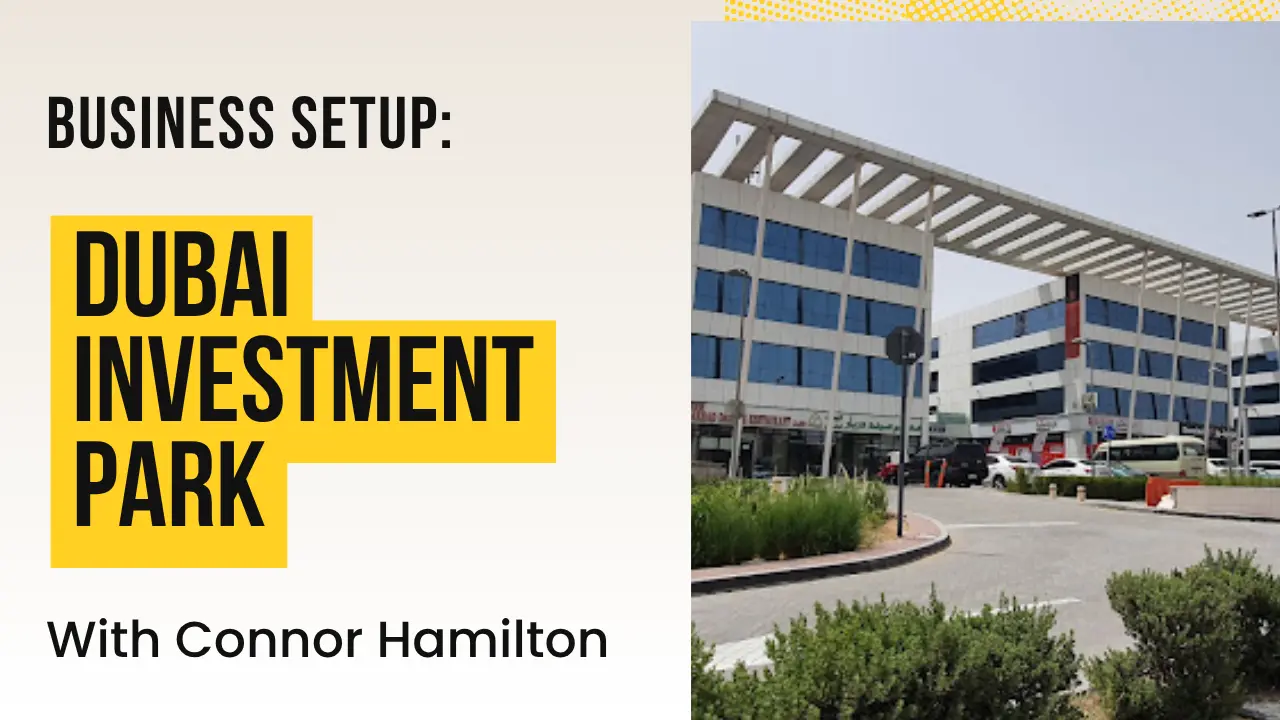
For companies, Dubai investment park functions almost like a free-zone-adjacent environment: 100% foreign ownership is available in most sectors, licensing is comparatively fast, and the area already hosts more than 3,500 to 5,000 registered companies across manufacturing, logistics, warehousing, food processing, and corporate services.
What sets DIP apart from a pure free zone is that it also permits mainland-style operations and residential presence in the same footprint, which is why it appeals equally to a logistics company needing warehouse space and a family wanting to live near the parent’s workplace.
Warehouse and Commercial Space: What Things Actually Cost
Warehouse rents in Dubai investment park typically run AED 18–35 per square foot annually, depending on power capacity (commonly 100–700 kW) and location within the development’s phases. Office and commercial space ranges far more widely — from roughly AED 30,000 to AED 388,000 per year depending on size and specification — and retail shop rentals average around AED 156,000 per year.
New warehouse stock delivering from early 2026 increasingly includes fitted offices and mezzanine levels, aimed at hybrid storage-plus-admin operations rather than pure storage, which is worth knowing if you’re comparing older stock against newer builds on price alone.
Dubai Investment Park as a Property Investment: The Numbers, Not the Pitch
This is where most content gets loudest and least reliable, so treat every number below as a range, not a promise.
Multiple 2026 market sources place Dubai investment park among Dubai’s higher-yielding apartment markets, with gross yields commonly cited in the 9–10.5% range — comparable to International City and Discovery Gardens, and notably above prestige areas like Downtown Dubai (4–6% gross) or Dubai Marina (6–6.8% gross). Studio apartments in DIP have been advertised from around AED 356,000–700,000, which is precisely why the yield percentage looks strong: the entry price is low relative to achievable rent, not because the rent itself is exceptional.
That distinction matters because gross yield is not what lands in your account. Net yield — after service charges, vacancy, and management costs — typically runs 1.5 to 2 percentage points below gross across Dubai generally. A 10% gross figure in Dubai investment park could realistically net closer to 7–8.5% once real costs are subtracted, which is still strong, but it’s a different number than the one usually advertised.
| Metric | Dubai Investment Park | Dubai-wide average (2026) |
|---|---|---|
| Gross apartment yield | ~9–10.5% | 6–8% |
| Studio entry price | From ~AED 356,000–700,000 | Varies widely by area |
| Capital appreciation | Moderate, income-led | Higher in central/waterfront areas |
| Buyer profile | Cash-flow investors | Mixed |
| Freehold status | Yes | Varies by zone |
The honest read: Dubai investment park rewards investors chasing rental income over prestige or fast capital appreciation. If your goal is resale value growth or a waterfront lifestyle asset, this isn’t the right zone — areas like Palm Jebel Ali or Downtown Dubai serve that goal better, at the cost of yield. If your goal is monthly cash flow on a modest entry price, DIP is one of the more defensible choices on the market, and multiple independent yield trackers agree on that point rather than just one broker’s marketing page.
What People Actually Ask About Dubai Investment Park
Is Dubai Investment Park freehold?
Yes. Both DIP 1 and DIP 2 permit 100% foreign ownership in designated freehold zones, and the area has held that status long enough that Dubai Land Department records treat it as an established freehold market rather than a newly opened one.
Is Dubai Investment Park a good place to live for families?
It suits families who value space, schools, and lower costs over proximity to central nightlife. Multiple international curriculum schools and a resident hospital/clinic network are already on-site, which reduces the daily friction that usually comes with living on Dubai’s outskirts.
How far is Dubai Investment Park from the airport?
It sits close to Al Maktoum International Airport (DWC) and a reasonable drive from Dubai International Airport (DXB) via E311/E611, which is one reason logistics and aviation-adjacent businesses concentrate here.
What’s the difference between DIP 1 and DIP 2 for investors?
DIP 1 is the more established, greener side with higher entry prices; DIP 2 skews industrial and staff-accommodation heavy, with lower entry prices and marginally higher yield potential, but less lifestyle polish.
Can I run a warehouse and live in Dubai Investment Park at the same time?
Yes — this is arguably DIP’s core structural advantage. Unlike a standalone free zone, DIP combines industrial, commercial, and residential zoning in one footprint, so business owners frequently base both operations and family housing inside the same development.
The Bottom Line
Dubai investment park isn’t one thing — it’s an industrial hub, a mid-market residential community, and a cash-flow-focused investment zone, all sharing the same postcode. The mistake most buyers and relocating businesses make is judging it against areas built for a single purpose, like Downtown Dubai (prestige) or Business Bay (corporate density), when DIP was never trying to compete on those terms. Judged on its own terms — yield, connectivity, licensing speed, and cost of living — it holds up as one of the more rational, if less glamorous, choices in Dubai’s property and business landscape.