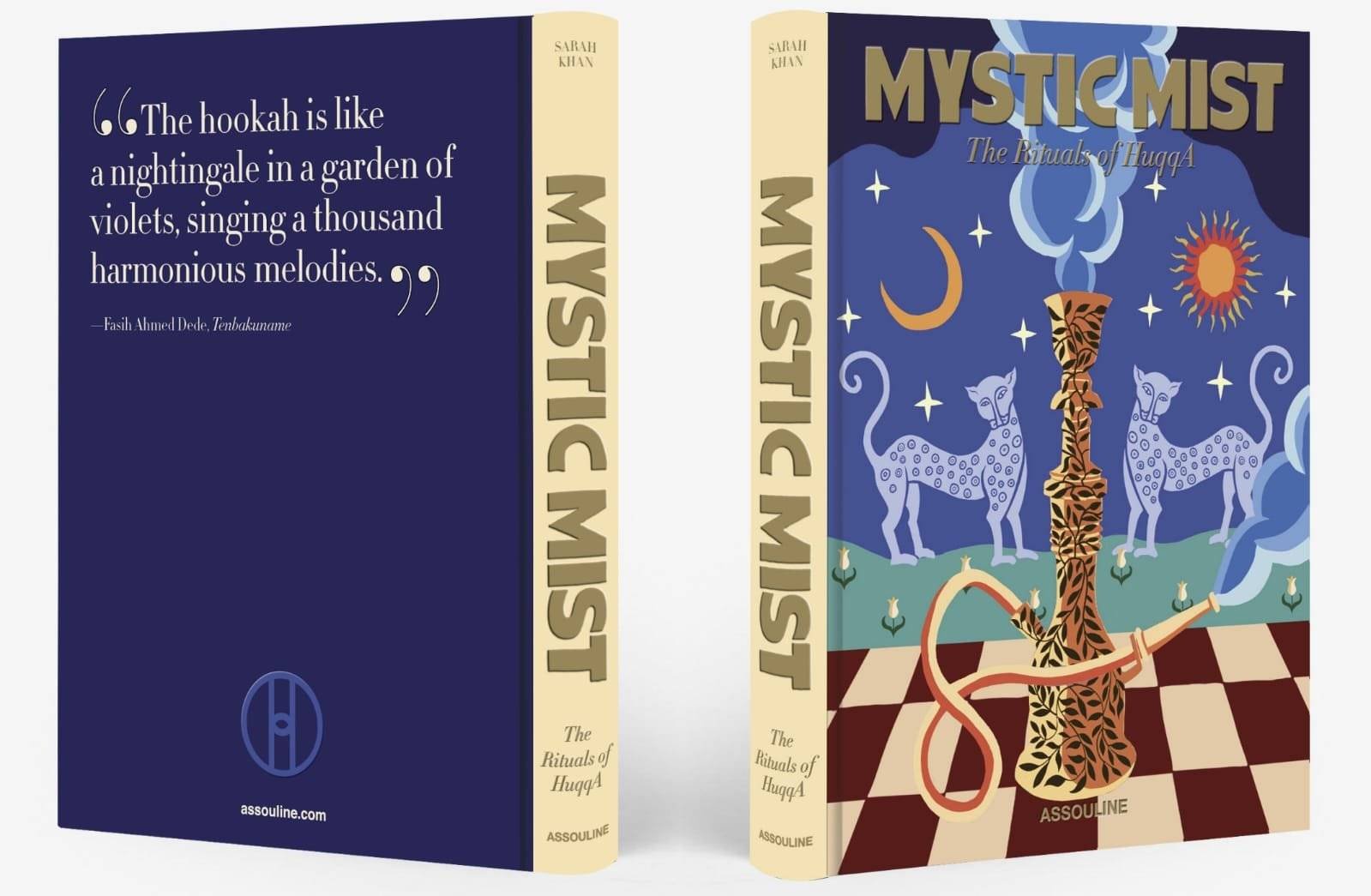
Released in the November 2025 Classics Collection, Mystic Mist The Rituals of HuqqA introduces a centuries-old ritual through the lens of contemporary urban life. The volume brings together narratives grounded in historical sources and oral testimony with scenes drawn from modern cities. Produced by Assouline, the book’s text is authored by journalist Sarah Khan, while the photography is by Oliver Pilcher.
As readers move through the pages, they encounter both traces of the past and today’s ways of coming together. The work compares how the ritual is understood and practiced in different regions. In doing so, it makes visible, within a single book, both the persistence and the evolution of a cultural practice over centuries.
Historical Context Is Woven Together With Today’s Experience
The narrative opens with Fasih Ahmed Dede’s well-known line from Tenbakuname and places the reader on a trajectory that stretches from imperial courts to present-day metropolises. Early practices shaped in the courts of the Mughal and Persian empires are presented as key components of social life.
The culture of gathering that developed in Ottoman coffeehouses is described as a setting that enabled social and literary exchange. The book also shows, through historical examples, how these habits, once carried to Europe, turned into fashionable customs among the era’s social circles.
New venue types and meeting formats that characterize modern cities are consistently linked back to this historical legacy. As a result, the reader follows a long cultural process rather than a single product or short-lived trend.
The Ritual’s Social Role Is Read Through Everyday Life
Mystic Mist The Rituals of HuqqA treats the ritual as more than a legacy of the past, presenting it as a living social practice embedded in daily life. The book underscores the human need to gather, slow down and talk face to face. Within this framework, it stresses the importance of brief pauses amid the speed of contemporary life.
The sentence, “Hookah in Turkey is still a social tradition with deep roots. It is not just smoke; it is a reason to sit, come together and talk,” is highlighted as a core quotation that encapsulates this perspective.
The same section notes that, especially for younger generations, the practice serves both as a cultural bond and as a means of stepping away from the noise of everyday routines. The work invites readers to take distance from their own schedules and reconsider how they socialize.
Sarah Khan’s Writing Connects Diverse Cultural Landscapes
Sarah Khan, who pens the book’s text, brings her extensive journalism background into the project. Specializing in travel, fashion and gastronomy, she previously served as editor-in-chief of Dubai-based Condé Nast Traveller Middle East.
Now a contributing editor at Condé Nast Traveler, Khan has produced reports and interviews from all seven continents for publications such as The New York Times, Wall Street Journal, Food & Wine, Vogue, Vanity Fair and Time. Her experience living in Canada, Saudi Arabia, India, South Africa, the United Arab Emirates and the United States allows her to bring multiple cultures into the same narrative frame.
In Mystic Mist, this trajectory is reflected in a tone that bridges historical accounts and contemporary city scenes. Her writing offers readers detailed observations grounded in fieldwork, set within a broad cultural context.
Oliver Pilcher Shapes the Book’s Visual Language
The book’s visual identity is defined by the photographs of Oliver Pilcher, who has been working with international magazines for more than a decade. Born in Scotland, Pilcher studied sculpture at Edinburgh College of Art before beginning his photography career in New York. His work is noted for capturing, in a single shot, the relationship between place, people and detail across different cities and continents.
In Mystic Mist, his images document the settings where the ritual unfolds, the objects that accompany it and the people who share the experience, all with a documentary aesthetic. These photographs anchor the historical and cultural narrative of the text in tangible scenes. As readers advance through the book, they engage with both words and images, encountering a multi-layered reading experience.
İrem Kınay, who serves as consultant to the project, is a long-established name in international art and culture publishing. Since 2010, she has played a role in realizing numerous book projects focused on the region. Her involvement is associated with works such as The Grand Bazaar Istanbul, The Light of Istanbul, Portraits and Caftans of the Ottoman Sultans, Ottoman Chic and Bosphorus Private, and she is also the author of Turquoise Coast.
This accumulated experience is evident in Mystic Mist in both the selection of material and the structuring of the narrative. Rather than centering on a single city, the book highlights the connections that link different geographies. In this way, it moves beyond a purely regional publication and positions itself as a reference work for an international readership.
Current Readings of Tradition Are Gathered in One Volume
The volume also brings together texts that focus on contemporary interpretations of the ritual. In a foreword written by HuqqA Chairman of the Board Cihan Kamer, attention is directed to the role this tradition plays in everyday life along a line extending from the Ottoman era to today.
Kamer underlines that it should not be viewed purely as a vehicle for leisure, but as a cultural expression of hospitality, conversation and shared presence. The sentence, “For many people, especially younger generations, the hookah is both a cultural bond and a way of breaking away from the noise of everyday life,” stands out among the key evaluations in the foreword.
Co-founder Enis Ersavasti defines the balance between heritage and innovation with the words, HuqqA was born out of a deep respect for tradition. Board member Mehmet Fevzi Yağlı offers an additional perspective by examining how the ritual is reinterpreted in contemporary venues across different cities through design and guest experience. Together, these contributions extend the book’s historical frame into the present.
Mystic Mist Emerges as a Cultural Resource for Global Readers
Mystic Mist The Rituals of HuqqA unites, in a single volume, the journey of the ritual from imperial courts to today’s metropolises, presenting a wide-ranging cultural resource for readers around the world.
The transitions between cities, spaces and individual narratives position the book not only as a visually rich work, but also as a contribution to social history. Published in November 2025 within the Classics Collection, the volume reaches readers through international publisher Assouline.
Alongside scenes from HuqqA venues in different cities, the book also includes Huqqabaz, the brand concept designed for a broader audience. In this respect, Mystic Mist arrives on shelves as a current point of reference for those who wish to follow cultural heritage and for readers seeking to understand the rituals that shape contemporary urban life.