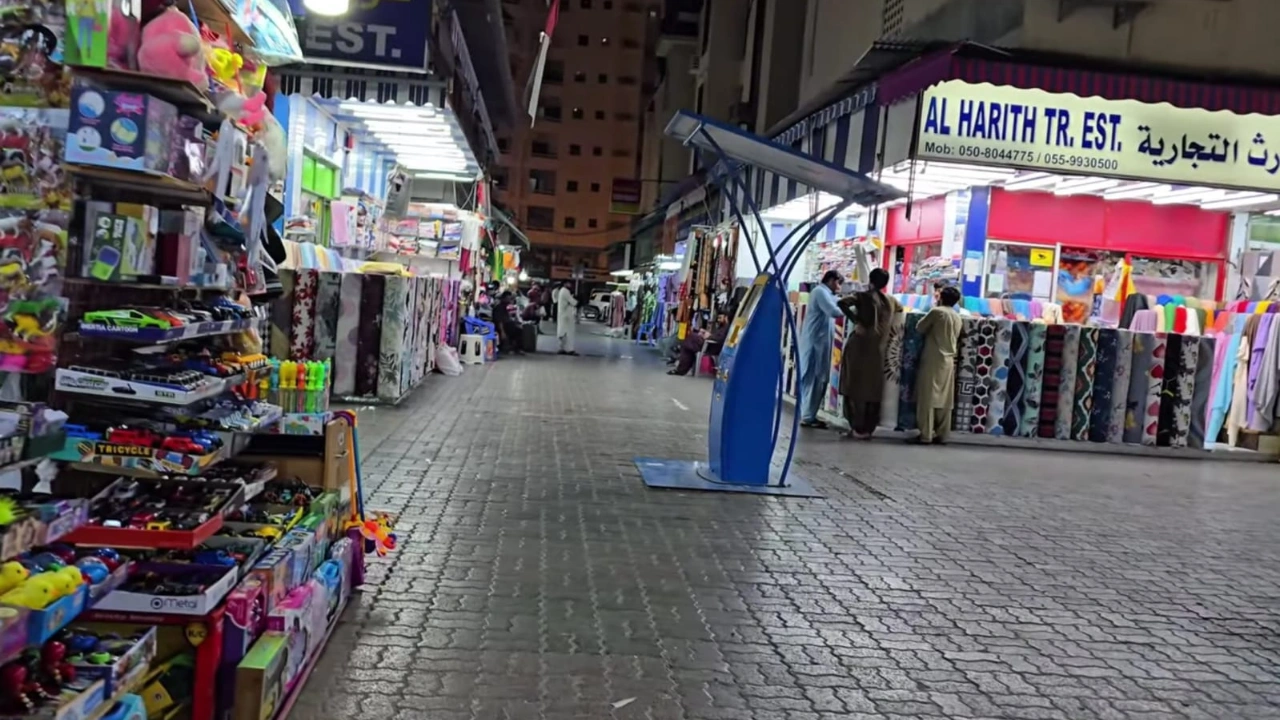
Rolla Market, also known as Souq Al Rolla, is an open-air street market in central Sharjah’s Al Ghuwair and Al Shuwaiheen districts, built around the Rolla Clock Tower and Rolla Square. It’s made up of independent shops and stalls rather than one building, split into distinct sections for gold, abayas and cloth, dates, fresh fish, and toys, with prices open to negotiation outside the gold and seafood counters.
- Wait, Which Rolla Are You Looking For?
- Where the Name Actually Comes From
- What You’ll Actually Find at Rolla Market
- The gold quarter
- The abaya and cloth lanes
- The dates market
- The fish market
- The toy market
- Everything else
- A Realistic Half-Day Route at Rolla Market
- Timings, By Section
- Bargaining, Done Right
- Getting There
- Payment and Practical Notes
- Who Should Actually Skip It
- What’s Nearby, If You Want to Extend the Trip
- Frequently Asked Questions
It’s easy to confuse with Rolla Mall, an unrelated enclosed shopping building nearby, or with Rolla, the wider neighborhood both sit in. This guide covers the market itself: what’s actually there, when each section is open, how to get in and out efficiently, and whether it’s worth your afternoon.
Wait, Which Rolla Are You Looking For?
This trips up more visitors than anything else, and most guides skip right past it. There are three different things called Rolla in the UAE, and confusing them will send you to the wrong side of town.
Rolla Market (Souq Al Rolla) is the open-air street market this guide covers, clustered around the Rolla Clock Tower and Rolla Square in Sharjah’s Al Ghuwair and Al Shuwaiheen districts. It’s a collection of independent shops and stalls, not one building.
Rolla Mall is an enclosed, multi-storey shopping building in the same general area, opened in the early 2000s. It has fixed retail units, fixed prices, and none of the bargaining culture that defines the street market next door. If a page talks about food courts, cinemas, and department stores under one roof, it’s describing the mall, not the market.
Rolla on its own refers to the wider neighborhood, one of Sharjah’s oldest and most densely populated districts, home to both the market and the mall along with residential towers, banks, and government offices.
If your plan is bargaining for spices and gold under the open sky, you want the market. If you want air conditioning and a food court, that’s the mall a short walk away. This guide sticks to the market.
Where the Name Actually Comes From
Long before shops arrived, a single enormous banyan tree stood at the center of what’s now Rolla Square. Locals called it “Rolla,” and it became the meeting point for traders and residents alike, the kind of landmark you’d give directions by. When the area urbanized, the name stuck to the square, then to the surrounding streets and eventually the market itself. Records of the area under this name go back to the 1820s, tied to the Al Ali tribe’s early settlement here as Sharjah grew into a trading port.
That history is worth knowing before you walk in, because it changes how the market reads. This isn’t a retail concept someone designed. It’s commerce that grew organically around a tree, over roughly two centuries, and never stopped.

What You’ll Actually Find at Rolla Market
Rolla Market isn’t one shop selling everything. It’s organized into distinct micro-markets, each with its own character and location, and knowing the layout before you go saves real time.
| Section | Where | What’s There |
|---|---|---|
| Gold quarter | Around Rolla Square | 18K to 24K gold, semi-precious and precious stones, Indian and Italian design pieces from Malabar Gold and Diamonds, Kalyan Jewellers, Damas, and independent jewelers |
| Abaya and cloth lanes | Behind Bank Street, Al Shuwaiheen | Daily and occasion abayas, fabric bolts, scarves, on-site tailoring |
| Dates market | Near Souq Al Jubail, Corniche Street | Fresh and dried dates from the UAE, Saudi Arabia, Oman, Jordan, and Palestine; Ajwa, Medjool, and stuffed varieties |
| Fish market | Near Al Jubail | Roughly 400 stalls and 100+ dedicated sellers; local hammour, imported salmon, and other fresh catch, cleaned on request |
| Toy market | Near Al Ghuwair | Toys, dolls, action figures, stationery, school bags, priced for bulk buying |
| General shops | Scattered throughout | Electronics, perfume and bakhoor, household goods, footwear, small groceries |
The gold quarter
Gold here is priced against the daily gold rate plus a making charge, and that making charge is exactly where bargaining room exists, especially on pieces that aren’t fresh-made that day.
The abaya and cloth lanes
If you want something custom-fitted, this is also where you’ll find a tailor who can turn a piece around in a day or two.
The dates market
Ajwa and Medjool are the names most visitors ask for, but the real value is in asking the vendor what’s in season, since prices swing noticeably by harvest.
The fish market
Most stalls will clean and gut your purchase on the spot at no extra charge. Go early. Mornings are when the catch is freshest and the crowds are thinnest.
The toy market
It’s a genuine option for party favors or classroom gifts rather than just single-item shopping.
Everything else
This is really the point of Rolla: you can walk five minutes and go from buying dates to buying a phone case to trying on abayas.

A Realistic Half-Day Route at Rolla Market
Most first-time visitors either wander aimlessly or try to see everything and burn out by noon. A tighter route works better.
| Time | Stop | Why This Order |
|---|---|---|
| 8:00–9:00am | Fish market | Freshest catch, thinnest crowds |
| 9:00–9:30am | Dates market | Right next door to the fish market |
| 9:30–11:00am | Gold quarter | Jewelers negotiate more freely before the lunchtime rush |
| 11:00am–12:30pm | Abaya, cloth, and general shops | Steady browsing window before peak heat |
| 12:30pm onward | Toy market, then air-conditioned break | Good reward stop if you’re visiting with kids |

Timings, By Section
Rolla doesn’t run on one master schedule, which catches people out. Each micro-market keeps its own hours.
- Gold shops: generally 10:00am to 10:30pm, daily
- Abaya and cloth markets: roughly 10:00am to midnight, daily
- Dates market: Saturday to Thursday 6:00am to 10:00pm, Friday 6:00am to 11:30am and 2:00pm to 10:00pm
- Fish market: Saturday to Thursday 8:00am to 10:00pm, Friday 7:00am to 11:30am and 1:00pm to 10:00pm
- Toy market: Saturday to Thursday 9:00am to 11:30pm, Friday 9:00am to 11:30am and 2:00pm to 11:30pm
Friday mornings run shorter across the board because of prayer timings, then most sections reopen in the afternoon. If you’re planning a Friday visit, aim for after 2pm.
Bargaining, Done Right
Bargaining at Rolla isn’t optional theater, it’s the actual pricing mechanism for most non-gold items, and a lot of first-timers either overpay because they’re too polite to negotiate, or offend a vendor by opening too aggressively.
A workable approach: ask the price, then counter at roughly 60 to 70 percent of what’s quoted for textiles, souvenirs, and general goods, and let the conversation settle somewhere in the middle. Walking away, even a few slow steps, is often what actually moves the price, not the counter-offer itself. Buying more than one item from the same stall almost always earns a better per-item rate.
Gold works differently: the metal price itself is fixed to the daily rate, so your negotiating room is entirely in the making charge, and it’s completely normal to ask two or three shops for their making charge before committing.
What doesn’t work well: negotiating hard in the dates or fish markets, where margins are already thin and prices tend to be closer to fixed, or trying to bargain during the Thursday evening and Friday rush, when shops have more customers than they need and less incentive to move on price.
Getting There
Rolla sits centrally enough in Sharjah that most visitors reach it in 20 to 30 minutes regardless of where they’re starting from within the emirate.
By car: the market is anchored around the Rolla Clock Tower roundabout, close to the Sharjah Corniche, and connects to King Faisal Street and Al Arouba Street, both of which link to Dubai and Ajman. Street and paid parking exist around the district, but weekday evenings and weekends get tight, and circling for a spot eats into your visit more than people expect.
By bus: local routes including buses #8 and #9 stop close to the market, and SRTA bus 313 connects Rolla to Dubai’s airport corridor, which makes it a realistic stop if you’re already moving between the two cities.
From Dubai: the E11 north gets you into Sharjah, and from there it’s a short run to the Corniche and Rolla. If you’re coming from Dubai specifically to shop, plan for traffic on the E11 during evening rush hour, since that’s the bottleneck more than anything inside Rolla itself.
Payment and Practical Notes
Most established shops, particularly the gold retailers and larger abaya and cloth outlets, accept debit and credit cards without issue. Smaller stalls, especially in the dates and fish sections, still run mostly on cash, and having notes on hand also gives you more room to negotiate than pulling out a card mid-haggle. Wear shoes you can walk a few kilometers in over a few hours, the market covers more ground than photos suggest, and carry a reusable bag, since not every stall provides one.
Who Should Actually Skip It
Most guides won’t tell you this part. If you’re chasing air conditioning, fixed pricing, and a predictable layout, Rolla Market will frustrate you, that’s what Rolla Mall or a conventional shopping center is for. If you’re visiting on a Friday or Saturday evening specifically, expect genuine crowding in the narrower lanes, not the relaxed browsing experience the photos suggest. And if bargaining makes you uncomfortable, gold and cloth shopping here will feel like a chore rather than a highlight, since price flexibility is baked into how the market operates.
If you’d rather go the air-conditioned route, check out our complete guide to Rolla Mall for shops, timings, and what to expect.
What’s Nearby, If You Want to Extend the Trip
- Rolla Square Park – sits right in the middle of the district; shaded paths and a genuine break from the crowds, useful if you’re shopping with kids who need a reset
- Sharjah Fort – short drive away; pairs well with a market morning if you want history alongside shopping
- Sharjah Art Museum – also a short drive away; a good add-on for rounding out the day beyond shopping
- Al Majaz Waterfront – close enough for an evening walk once the day’s shopping is done
Frequently Asked Questions
No. Rolla Market is the open-air street souq covered in this guide. Rolla Mall is a separate, enclosed retail building nearby with fixed-price shops, food courts, and standard mall hours. They share a name because both sit in the Rolla district, but they’re run and priced completely differently.
It depends which section you mean. Gold shops generally run 10am to 10:30pm, the fish and dates markets open earliest around 6 to 8am and close by 10pm, and the toy and cloth markets stay open latest, often until midnight. Fridays run shorter mornings across the board.
Yes at most established shops, particularly gold, abaya, and cloth retailers. Smaller stalls in the fish and dates sections lean cash-heavy, so carry some with you.
For textiles, souvenirs, general goods, and gold making charges, yes, it’s the normal way prices are set. Dates and fish are closer to fixed pricing since margins are thinner.
Yes, it’s a genuinely family-oriented, everyday shopping area used by residents, not a tourist trap. The narrower lanes do get crowded on weekend evenings, so if you’re visiting with young kids, mornings or early afternoons are more comfortable.
Street and paid parking are available around the district near the Clock Tower and Rolla Square, though spaces fill up quickly during evenings and weekends. Arriving before midday or using the bus gives you an easier visit if you’re not committed to driving.
Weekday mornings, roughly 10am to noon, are consistently the calmest window. Thursday evenings through Saturday are the busiest, and Friday evenings specifically tend to be the most crowded of the week.