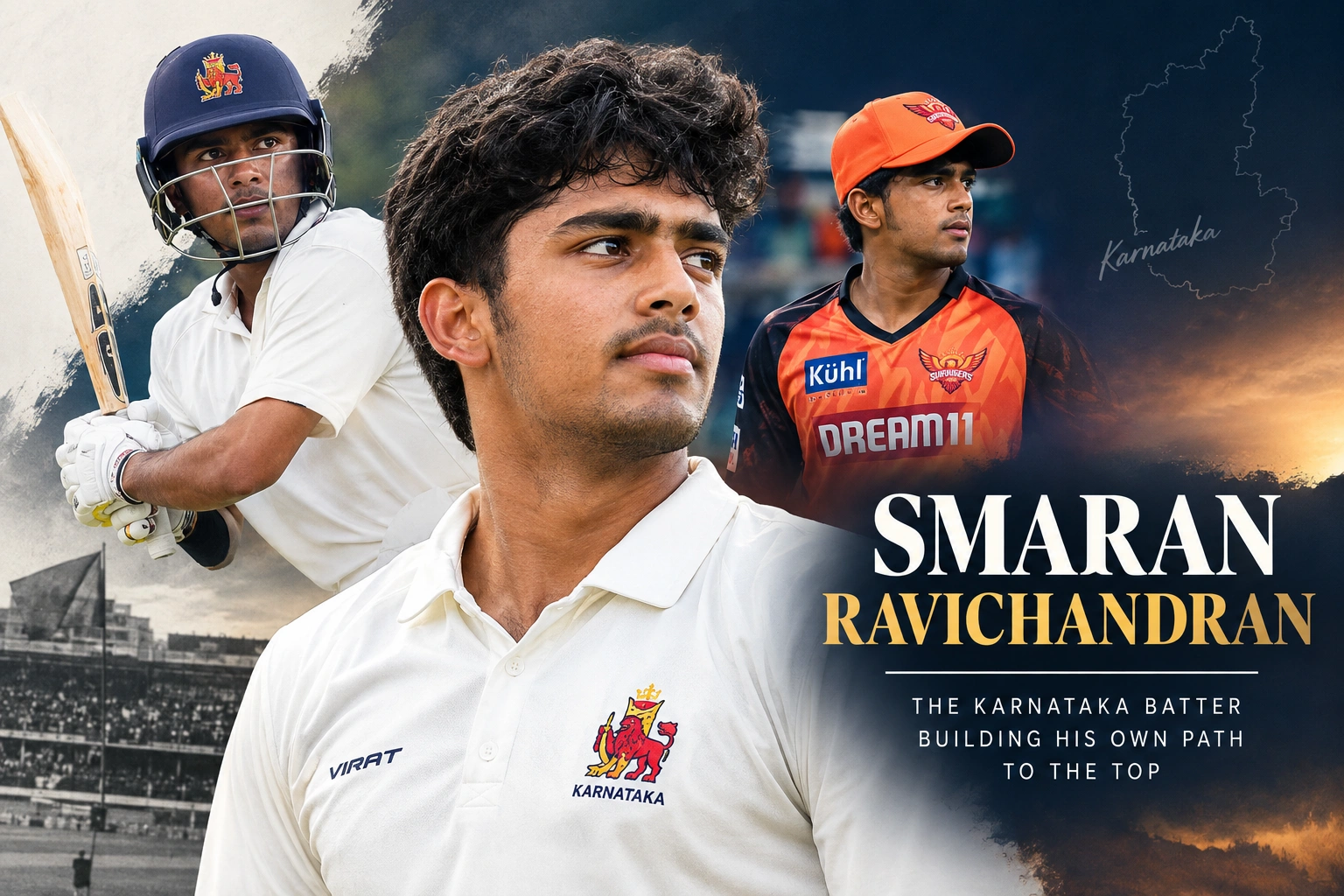
Indian cricket has never been short of talented young batters. What makes some of them stand out, however, is not one spectacular innings but the ability to keep producing runs when the attention starts to grow.
- A Cricket Career That Started Almost by Accident
- From Karnataka’s Age-Group System to Senior Cricket
- The Ranji Season That Changed the Conversation
- Why His Batting Has Attracted Attention
- The IPL Opportunity Arrived
- His Focus Has Remained on Karnataka
- Duleep Trophy Gives Him Another Stage
- The Bigger Picture
- What Comes Next for Smaran Ravichandran?
Smaran Ravichandran is beginning to build that kind of reputation.
The Karnataka batter has moved quickly through domestic cricket, from age-group cricket to becoming one of his state’s most productive run-scorers. His rise has included a title-winning Vijay Hazare Trophy final in 2024-25, a record-breaking Ranji Trophy season in 2025-26, an IPL opportunity with Sunrisers Hyderabad and, most recently, a place in the South Zone side for the Duleep Trophy.
At 22, he is still at an early stage of his career. But the numbers, the way he talks about the game and the quality of his recent performances suggest there is a bigger story developing.
A Cricket Career That Started Almost by Accident
Smaran’s introduction to cricket was not the usual story of a child dreaming from day one of playing professionally.
Growing up in Bengaluru, he was an energetic child, and his mother enrolled him in cricket coaching partly to keep him occupied. At the time, there was little indication that the decision would eventually lead to professional cricket.
That changed as Smaran became more competitive.
His coach, Syed Zabiulla, played an important role in that transformation. What began as a recreational activity gradually became a serious pursuit, and by the Under-14 level, Smaran had started to see cricket as something he could pursue professionally.
His early development was also unusual in another way. He continued to take his education seriously while progressing through Karnataka’s age-group system. He scored 92 percent in his Class X ICSE examinations while also playing Under-16 and Under-19 cricket, according to his coach.
That balance between academics and cricket has remained part of his story.
From Karnataka’s Age-Group System to Senior Cricket
Smaran’s progression through Karnataka cricket was gradual rather than overnight.
He played age-group cricket before making his senior debut for Karnataka during the 2024-25 domestic season. Once he entered the senior setup, however, his ability to produce substantial scores became difficult to ignore.
One of his defining first-class performances came against Punjab, when he scored 203 in the Ranji Trophy. It was his first-class breakthrough and a sign that he could handle the demands of long-format cricket.
His performances in limited-overs cricket were equally significant.
In the 2024-25 Vijay Hazare Trophy final against Vidarbha, Smaran scored 101 off 92 balls, helping Karnataka post 348 for 6. Karnataka went on to beat Vidarbha by 36 runs to win the title, with Abhinav Manohar’s late assault sealing the win. Smaran’s century earned him Player of the Match honours.
For a young batter, it was the sort of performance that can change how a domestic career is viewed.
The Ranji Season That Changed the Conversation
If the previous season introduced Smaran to a wider audience, his 2025-26 Ranji Trophy campaign established him as one of Karnataka’s most important batters.
He finished the season with 950 runs in 9 matches (14 innings) at an average of 86.36, including four centuries and three fifties — the most runs by any batter in the competition that season. His highest score was an unbeaten 227.
That innings came against Chandigarh, where Smaran and Karun Nair put together a match-defining stand as Karnataka built a huge first-innings total; Karnataka went on to win by an innings and 185 runs. It was his second double-century in three matches and his highest first-class score at the time. He also struck an unbeaten 220 against Kerala and twin centuries (135 and 127) in the semi-final against Uttarakhand, a match in which his 343-run fourth-wicket stand with Nair was the highest partnership of the season.
What makes the season particularly interesting is that it came during only his second full domestic season.
There is often a drop in performance after a young player has enjoyed a breakthrough year because opposition teams begin to understand their strengths and weaknesses. Smaran managed to avoid that second-season dip — instead, he became more productive, briefly putting him within reach of the rare 1,000-run mark in a single Ranji season.
That chase for 1,000 runs ended in disappointment. Karnataka reached the final against Jammu & Kashmir, appearing in cricket’s biggest domestic final for the 14th time, but were beaten to the title on first-innings lead after J&K posted 584 to Karnataka’s 293. Smaran himself was dismissed for a golden duck in that innings — a reminder that even a standout season can end on an anticlimactic note. J&K’s win was their first-ever Ranji Trophy title.
Why His Batting Has Attracted Attention
Smaran is a left-handed batter, but his appeal is not simply about being another young stroke-maker.
His domestic performances have shown an ability to play long innings, adapt to different match situations and shift gears when required.
His coach and Smaran himself have spoken about training with different formats in mind. The idea was to make him comfortable building an innings patiently before increasing the scoring rate, rather than turning him into a batter who relies only on attacking cricket.
That approach has become increasingly visible in his first-class performances.
He has also retained an interest in off-spin, although batting has clearly become his primary skill. As a teenager, he played more as an all-rounder before focusing increasingly on his batting.
The IPL Opportunity Arrived
Smaran’s domestic performances eventually opened the door to the Indian Premier League.
Sunrisers Hyderabad signed him as a replacement for Adam Zampa during the 2025 season. He was unable to play that season after suffering an injury, but the franchise retained him for the 2026 campaign.
That opportunity finally arrived in 2026.
Smaran made his IPL debut for Sunrisers Hyderabad during the season and appeared in six matches, although his opportunities with the bat were limited. He finished with 19 runs from four innings.
On paper, those numbers do not tell a particularly exciting story.
But the experience was important.
Smaran later described the IPL stint as a valuable learning curve, particularly because of the opportunity to share a dressing room with established players such as Pat Cummins, Travis Head, Ishan Kishan and Abhishek Sharma.
For a young domestic batter, spending time in that environment can be as important as the number of runs scored.
His Focus Has Remained on Karnataka
One of the more interesting aspects of Smaran’s recent interviews is that he does not appear to be in a hurry to define his career through the IPL alone.
His domestic cricket remains central to his ambitions.
After scoring 950 Ranji Trophy runs, he missed selection for India’s A tour of Sri Lanka. Instead of treating that as a major setback, he spoke about using the experience as motivation to score even more heavily.
His next target was straightforward: turn 950 runs into somewhere around 1,000 to 1,100 in the following Ranji season.
That mindset says something about where he believes his route to the Indian team lies.
Not through hype.
Through runs.
Duleep Trophy Gives Him Another Stage
The next opportunity came with South Zone in the 2026 Duleep Trophy.
Smaran was selected in a strong South Zone squad led by Tilak Varma. The team reached the final after defeating North Zone in the semifinal, with Smaran finishing the chase alongside Varma on 32 not out.
The final against East Zone at Chennai’s MA Chidambaram Stadium proved much tougher.
East Zone posted 708 in the first innings, led by Ishan Kishan’s extraordinary 270. South Zone were bowled out for 336, with Smaran contributing 23 from 55 balls. East Zone eventually won the title on first-innings lead after the match ended in a draw.
It was not Smaran’s biggest performance, but the match represented another step in his development against some of the country’s strongest domestic players.
The Bigger Picture
There is still a long way to go.
Smaran has played only a small number of senior seasons compared with established Indian batters. The IPL has shown him the level of competition at the top, while the Ranji Trophy has given him the opportunity to prove that he can consistently build big innings — even if his two biggest finals so far, the 2025-26 Ranji final and the 2026 Duleep Trophy final, both ended in defeat for his side.
Indian cricket’s middle order is fiercely competitive, and one good domestic season is rarely enough to secure a national call-up. Smaran will need to keep producing across multiple seasons and formats.
The encouraging part is that he appears to understand that.
His recent interviews have focused less on instant recognition and more on improving his output, understanding the game better and helping Karnataka win trophies.
What Comes Next for Smaran Ravichandran?
The next phase of his career could be particularly important.
He has already experienced the jump from age-group cricket to first-class cricket, the pressure of a major domestic final and the environment of an IPL franchise. He has also finished a Ranji season as the competition’s leading run-scorer.
Now the challenge is consistency.
If he can reproduce that level of performance over another full domestic season — and finally get his hands on a trophy in a big final — the conversation around his future could become considerably louder.
For now, Smaran Ravichandran is best viewed not as a finished star but as a young batter who has already done enough to make people pay attention.
His story is still being written.
And, judging by the number of runs he wants to add to it, he is unlikely to be satisfied with where it stands today.